Pages

Showing posts with label IAL#130 HOLD. Show all posts

The Attack on Middle Class/Working Class America Continues:

by Glenn Littrell

The attacks didn’t start with state workers across the country. The campaign has been ongoing for years. Facing a potential stalemate in a divided Congress the emphasis shifted from Postal Workers and large private sector unions to waging war on the middle class working family by attacking public service employees. This shift however is not a change in the anti-working family agenda of right-wing conservatives it is just a broadening of the frontal assault that was brought on by inflated Tea Party victories of the 2010 elections.

The Republican members of the House Committee on Oversight and Government Reform have focused their sites, as promised, on attacking the biggest public service workforce of them all, Postal Workers. [see links and video below]

It is estimated that about 40% of APWU members are more conservative than liberal [the figure is higher when you factor in non-members [free-loaders]]. It is this group that is slowest to acknowledge the threat to their jobs and tend to ignore the right-wing attacks on their jobs. They tend to feel that those attacks are directed towards their co-workers, not them, or they feel comfortable that their seniority will protect them. What they fail to realize is that Wisconsin working families also didn’t think the right-wing attacks were directed at them individually and they also felt their seniority would protect them too. Now they know better.

Wisconsin workers now realize that they have been voting against their best interest by supporting candidates who only give lip service to family values issues every election, but give true service to a pro-corporate agenda that finances their political campaigns. In several of the states that worker rights are under attack there have been some type of pro-corporate tax cut or tax subsidies for high income individuals or corporation. How did they go from their ‘create jobs’ campaign during the election to their ‘job destruction’ agenda across the country? The events of the last six months in Wisconsin has highlighted that working class America, middle class America, family values America, union families and unemployed working families are not distinct groups, but are overlapping, entwined and inseparable from the fabric of our society. These realizations should not be lost on Postal Workers, liberal and conservative, because the fight against the working class is not going to be limited to your liberal co-worker or state employees.

The attacks on postal workers continue with House hearings attacking our recently negotiated contract. Even with its flaws the first reaction of most Postal Workers was to wipe the sweat from their forehead and breath a sigh of relief that there weren’t facing give backs or pending arbitration.

During World War II it was the working class that fought the war and built the war machines. Following the war it was the working families that expanded our infrastructure and fought the Korean War. This working class, the working families, their unions and the GI Bill is what built the American middle class following the depression. It wasn’t the middle class that caused the Great Depression anymore than it was the middle class that caused the current ‘Great Recession’. It was Wall Street and Corporate greed that caused both. It is time that we realize that the pro-corporate mantra that ‘What is good for business is good for America’ is a fallacies and adopt the more proven observation that what is good for the working family is good for America. Business has and will always take care of itself.

GlennDL

As we see the attacks on and the damage done to state level workers play out, Postal Workers should consider the words of Pastor Martin Neilmoller:
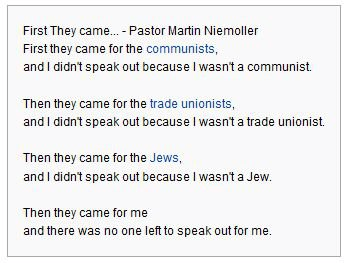
image

They’ve attacked everyone who disagrees with them as ‘socialist’, now their attacking state public servants and unions, and we’ve heard their plans for postal & federal workers. When will you realize that you are not exempt from their list of transgressors just because you think you’re one of them.


They aren’t Nazi’s or Fascist and this isn’t pre-war Germany, but the tactics are similar and proven. Divide and conquer use fear and hate to push their anti-worker agenda. Stand-up speak-out before its too late.

Return to Indy Info [Front Page]

A Hard Year for Working Families: A Labor Day Message.


by Glenn Littrell: AUGUST 2011 Indy Info

Since last Labor Day the countries pre-midterm election obsession with a down economy, massive unemployment and anti-tax rhetoric has shifted to a pro-corporation, anti-worker and social re-engineering attack on middle-class America. By middle class I mean people who have to work for a living not those trust fund babies who are well enough off to set-back and let their money work for them. or those that can set on their ‘capitol’ while holding the economy captive under the guise of ‘tax-increase’ uncertainty, or the ones who claim ‘small business’ status even though they employ few but rake in millions.
By middle class I mean working class:
middleclass

  • people who take home a paycheck and pay income taxes, people who paid into Medicare, Social Security, and unemployment insurance with an expectation that those safety nets would  be there when they needed them. Safety nets, not investments.
  • people who work hard and too often live paycheck to paycheck, medical bill to medical bill or social security check to social security check.
  • the people who are truly small business because the word small means small. Businesses that start from scratch and are building towards success, not businesses who hide behind their ‘small business’ label to reap low interest government loans, grants and incentives. Not businesses with million dollar revenue streams and paid lobbyist and unlimited campaign donation funds.
 
Last years election saw a groundswell of newly elected state and federal ‘Tea Party’ candidates winning elections on the basis of jobs, economy and taxes. They avoided and disowned any concern for social issues.  Yet since taking office they have provided no jobs program [as of July 24th, 200 days with no jobs bill under House GOP Majority's “So Be It” agenda, the “Where are the jobs’ mantra of the republican party candidates in October became the “So be it"  agenda in Feb when advocated Federal Job cuts]. With no jobs program, a one-sided approach to deficit reduction that hurts the working family and a new found obsession with social issues we have seen plenty of attacks on senior citizens, women, education, unions and civil liberties from state and national bodies. The only election issues that have survived have been the ones many of us feared and the rest of us didn’t realize were there. While giving tax breaks to corporations at the state level we saw budget woes being used to attack teachers, public servants and local governments. Who knew that changing the legal definition of a rape victim from ‘victim’ to ‘accuser’ was so important?HuckKonopacki_March2011_thumb[8]
The attack on state workers has manifested itself in the form of stripping collective bargaining rights, removing job protection, benefits and seniority. But these attacks are not just occurring at the state level. You and I as postal workers are are facing the same dilemma:
  • Even before we ratified our new contract newly elected Republican congressman summoned Postmaster General Donahoe and APWU President Guffey to committees meetings to attack the new contract.
  • Numerous critical statements, many exaggerated, misstated or outright untrue have been made by Republicans and right-wing media. These statements mirror and bolster the same claims made against state and federal workers.


Right To Work Laws.jesse
The irony of all this is that most postal workers have ignored the alarm sounded by their union for years. These attacks on state workers did not precede the attacks on postal workers but actually grew out of the pro-privatization, pro-corporate, anti-postal workers movement of the last 30 years. A prime example is the miss-named “Right to Work” legislation that has flooded state legislatures across the country. What this legislation does is remove the requirement that employees pay union dues when represented by a union. On the face of it you might think that its only fair that if someone doesn’t want to join the union they shouldn’t have to. If it was just about joining or not joining then it might be that simple, but there is always more.
By not joining does that mean they don’t ‘join’ the dues paying members in the benefits that have been won by the union? Does that mean that they don’t get union representation when their job is threatened by rogue management? Does that mean they don’t get the benefits of new contracts when the union has spent much time, effort and money negotiating them? Does that mean they don’t get the same benefits, retirement, medical, COLA, vacation, sick leave, overtime and breaks that the dues paying member gets? The answer to all these questions is NO! Under right to work laws they still get everything the dues paying member gets except they get it for FREE. So you see its not just as simple as join and pay or don’t join and don’t pay because their is the issue of paying for what you get. If a non dues paying employee reaps the benefits paid for by dues paying members then what results is two things:

  1. A class of self-entitled freeloaders,
  2. and Union that over times is destroyed by a continued drain of its resources by that self-entitled class of freeloaders.


 APWU members at the Indiana State Capitol protest.

Indiana Postal Workers at the State House Protest

If you don’t think that these state level right to work laws and the other attacks on state workers affect you then consider this:
The right to work laws have been in place and hindering the unions that represent postal workers for years. That’s right, the post office operates under the right to work ‘illogic.’ The right to work rules weaken postal workers by creating the class of entitled freeloaders that drain our financial resources, tax our ability to adequately represent dues paying members by requiring unions to also defend the entitled non-member and undercut morale by letting these freeloaders not just to enjoy the befits paid for by their co-workers but also to undercut their co-workers with their anti-union bull****.
The attack on  other federal workers and state workers are related to the attacks on us. The states are a battleground for testing anti worker rhetoric and tactics as well as building a so called ‘grassroots’ constituency [Google the word
Astroturfing] against public employees, meaning you and me. This is why earlier this year members of Indianapolis Area Local #130 and other Postal workers from around the state marched in support of state workers and democratic legislators who boycotted the state legislature. This is why you should look at this coming Labor Day as the moment that you start taking notice of the forces that work for you and recognize those that are working against the working family. Get involved in you local. Attend the Labor Day Parade. Develop an interest in Labor issues that affect your financial well being.
In closing I have a rhetorical question for you. Its rhetorical in the sense that the correct answer is that both are important and the total abdication of one in favor of the other is not desirable, but for the sake of defining your position which is the more important statement to you:

  1. What’s best for business [corporate America and Wall Street] is best for America.
  2. or… What’s best for the working family is best for America.

Think about it,


Glenn Littrell, Editor

Return to Indy Info-Online [front page]

Postal Crisis: The Issues

by Glenn Littrell
Confused about how the Postal Service got into this mess? It didn’t happen by accident. For over 200 years the Postal Service has survived recessions, depressions, invasions (Revolutionary War, War of 1812), Civil War, World Wars, Cold Wars and Prohibition. Technology that was supposed to eliminate it but didn’t: the stagecoach, the steamboat, the telegraph, the telephone and the fax machine.
The decline of the mail order business, faster transportation and the interstate highway system were supposed to lead to the demise of the Postal Service. Yet the Postal Service makes Amazon.com, E-bay and NetFlix possible and after nearly a century of being the main impetus behind local and state highway/road systems the Postal Service increased their relevance and efficiency as a result of the building of the interstate highway system.
The Postal Service has survived and thrived through all of this but now we are in a crisis?
The crisis exist not because the Postal Service has become a victim of unforeseen or naturally occurring economics calamities. Declining volume and the recession have had an impact, but the Postal Service has survived worse. The crisis is not caused by the Unions forcing concessions. Pay increases have been modest, employees contribute to their retirement and health insurance and there has not been a job action since 1970.
The Postal Service is where it is now because in 2006, following three years of profit without a stamp increase, the forces of privatization* came together and managed to pass devastating legislation that saddled the Postal Service with unsustainable financial obligations that doomed it to financial ruin. Fulfilling the objectives of the Privatizers: run the service into the ground until the public becomes accepting of the idea of privatization.         
*right-wing republicans, corporate America, and forces within the upper levels of the Postal Service (reference last two Postmasters: Henderson & Potter)
oct
For a clearer understanding of the issues view the following videos and then click here to review current postal legislation in the House and Senate. The last two videos are for a perspective.

The Postal Crisis: Manufactured Myth

IndyInfo Article: October/December Issue under the title “The Postal Crisis: The Issues”
see also previous post/article here: “The Postal Crisis: The Issues

Is It the Recession?

Whenever the Postmaster addresses Congress, makes a video or gives an interview it is sometimes hard to tell if he’s trying to save the post office or sell it off. Blame it on the recession, low volume or the internet one minute then blame it on labor cost, manpower the next.

  • The problem is that the economy and mail volume are cyclical which means that they will recover. Maybe not to past levels but the idea that we dismantle and gut the postal service makes little since.
  • The internet may have an impact but it is greatly exaggerated. Pointing out that 50% of households have internet access ignores the fact that the access is usually in the hands of the junior members of the households who are playing games, downloading music and socializing with people they were never going to mail a letter to anyway. Most online banking is online in the sense of your connection to the bank, but when it comes to the bank making the payment much of the time their still cutting a check and mailing it. In addition where 1st class letter volume is down package volume has increased because of the internet and as the economy improves online purchases and advertising mail will increase rapidly. The question if we dismantle our infrastructure now will we be able to handle the increase in the future?
  • In spite of increased productivity over the last decade postal workers have not engaged in any job action since 1970. We’ve done our job and followed the contract even as management has violated it to the tune of millions of dollars. Contracts have been negotiated or resolved in arbitration. We never flinched during the anthrax attacks. Our pay increases have been modest and we contribute to our health insurance and retirement. Our retirement funds have big surpluses. In spite of a reduction in force through VERAs and attrition we have increased our productivity in the face of excessing and other stressful conditions. So to blame labor for the current crisis is disingenuous.

It is interesting that everything the Postal Service is asking Congress for and everything that the Congressional right-wing is advocating for has been on their agenda over the last 10-30 years! Apparently the recession driven drop in volume is a convenient catalyst to their public argument that the post office is poor performing, bloated and wasteful in spite of the fact that it is the only successful self-sustaining government entity in this countries history.

As problematic as some of the items mentioned above are they do not require the dismantling of the Postal Service, nor do they warrant the attacks on postal workers and their collective bargaining rights. The post office can weather those storms and continue on.

It Is Not The Recession.

To understand how we got here, where things have gotten so bad so quickly, you need to strain your memory and remember all the bad decisions and choices upper management has made since you have been at the Post Office. You then have to look at all of the political attacks that have occurred through the Presidents Commission on Postal Reform, Senate Bill 1507, etc. and most importantly the Postal Accountability and Enhancement Act of 2006 (PAEA).


Now compare how things have changed:

  • We’ve cut manpower to the bone and run the station and branches with skeleton crews as the lines in the lobby get longer and longer.
  • We’ve seen commercials that discourage customers from going to their post office, actually portraying a visit to the post office as a nightmarish journey.
  • As we’ve increased productivity and automation we continually lower our service standards. We use to emphasis getting the mail from one point to the next as quickly as possible. In the process we would take observational counts to measure our productivity. Remember counting and weighing mail? But now we put the emphasis on counting the mail to make productivity and when we’re done counting it then we move it along.
  • It is routine for mail to sit, the machines to sit idle, and the employees who run the machines to stay busy working the mail by hand until the mail backs up enough to get a good ‘production’ count on the machines.
  • We use to keep classes of mail separate, but more and more we are intentionally, whether proper or not, mixing the mail.

Now add the observations above, your knowledge of the inaccuracy and misleading statements from politicians and consider this:

How Privatization Works:

  1. First the privatizers float the idea of privatizing a government service.
  2. If the public is supportive of the idea its full speed ahead.
  3. If the public opposes the idea then the privatizers back-off publicly.
  4. But behind the scenes they orchestrate the demise of the service by attacking it, underfunding it, under manning it, restricting it, and legislating it until the service becomes so bad that the public starts to accept the idea of privatizing it.

Sound familiar?

What The PAEA Did:

From 2003 to 2006 the postal Service was performing in the black, profiting. From 2003 to 2006 there were no stamp increases.

In 2006, the Republican Congress passed and the Republican President signed into law PAEA. This required the Postal Service to pre-fund its retirees health benefits (RHB) far into the future. The formula for computing the payments was so excessive that if it had been in effect the previous three years it would have wiped out those profits which occurred during record levels of volume and no recession.

In 2007, the first year under the draconian PAEA the postal service went from a 900 million profit to a 5.1 billion deficit. This was pre-recession. Additionally any drop in volume for that year would not have led to any losses because if you remove the RHB payment from that year the Postal Service would have realized its second most profitable year of the decade.

There is little doubt that the recession and the drop in volume would eventually have an impact but the biggest figure on the board is RHB payments. Without them the Postal Service would not be approaching its debt limit which is what triggers the ‘bail out’ propaganda.

oct

Is It About Privatizing?

Since President Ronald Reagan floated the ideal of Postal Privatization it has been out there, it has not gone away it has just gone unnoticed. It has been the great conspiracy to unionist and the mythical 'boogie-man' to skeptical postal workers, but the threat is real.

Most postal workers see little logic in the ideal that any private company would want to take over any of the non-revenue producing postal operations. It doesn't make since to privatize when the majority of operations would have to go back on the tax roles as the few revenue producing operations were sold off. But it doesn't have to make since it just has to make money for the special interest. An uninformed public would be none-the-wiser.

While some privatization of some government services does make since most of it is a smoke screen for creating profit opportunities at the expense of government services. The privatization of the postal service would not necessarily be a case of revenue generating operations being sold off to profiteers and the postal workers who survived the lay-offs being moved to non-revenue operation as government paid postal employees.

The ideal that corporate America could not find a way to make money off of the non-revenue generating operations such as transportation and plant operations is short sighted. Evidence of how it could be done is already in existence, it’s called sub-contracting.

The privatization of the postal service could create an industry that would rival the military industrial complex of the cold-war era. Postal employees who are gambling on surviving the take-down of the post office are going to be in for the same shock that tax payers will realize when the dust settles.

I have gone through privatization before (as a city employee), but I don't have a crystal ball, so I can't say exactly what will happen. I can only speculate what might happen and tell you that while the above is a worst case scenario I can guarantee you that privatization is never fair, seldom predictable and always politically motivated. The threat is real and all you have to do to see it is look at the logic and implementation of the PAEA, its devastating effect on our revenue and the never ending right-wing assault on unions, public employees and the Postal Service.

While I am willing to go deeper into the motives behind privatization and other ways it could play out those are arguments for another article at another time.


The Attacks Continue: H.R.2309

On September 21, 2011 the House Postal Subcommittee passed H.R.2309 out of the subcommittee. The vote was 8-5 with all 8 Republicans voting for the bill (including Rep. Dan Burton (R-IN)) and 5 Democrats voting against. The bill was co-Sponsored by the House Committee on Oversight and Government Reform Chairman Darrell Issa (R-CA) and the sub-committee chair Rep. Dennis Ross (R-FL) both Republicans.

Passage of the original bill would have had a devastating effect on the Postal Service as we know it and would do little to fix the main source of the Postal Services woes, the PAEA of 2006. But to make matters worse prior to the vote Rep. Issa amended the bill to include even more controversial provisions than the original bill.

That amended provision grants authority to a newly-established control board to carry out layoffs, overriding the no-layoff protection contained in postal union contracts.

“In addition, it says that employees who are eligible for retirement must be laid off before employees who are ineligible, and dictates that retirement-eligible employees with the longest service must be separated first. The new language also forbids the payment of severance pay to retirement-eligible employees.”

APWU News Bulletin 22-2011, Sept. 21, 2011

The bill also creates two unelected entities that would have the authority to carry out lay-offs, cut pay and reduce benefits. These entities would circumvent Congressional oversight and our collective bargaining rights, i.e., the contract.

see also:

Page 5: Commentary
HR 1351

H.R. 1351 Fact Sheet:

H.R. 1351 takes the necessary first steps toward ensuring a financially sound future for the United States Postal Service. The bill was drafted with three major components:

  1. It calls on the OPM to recalculate the USPS surplus in the Civil Service Retirement System within six months of enactment, using a methodology that fairly allocates the cost of pensions between the Post Office Department and the U.S. Postal Service.
  2. Then, once the accurate “postal surplus” is determined by the OPM, the agency would have 15 days to transfer the surplus to the PSRHBF.
  3. Direct the OPM to permit the USPS to use most of its $6.9 billion surplus in the FERS system to satisfy two obligations in FY 2011: a $5.5 billion payment due to the PSRHBF, and a $1.2 billion estimated payment to the Department of Labor for Federal Employees Compensation Act (workers comp.) expenses.

Any remaining funds would be used to reduce the Postal Service’s normal cost-percentage for FERS in future years.

H.R. 1351 does not address the legally mandated pre-funding payments into the PSRHBF beyond the FY2011 payment, which costs the USPS $5.5 billion annually. Rather, it simply fixes the massive over-funding to the postal CSRS and FERS accounts. Additional legislation would be necessary to repeal the future scheduled pre-funding payments to the PSRHBF.

Additionally, the date of the transfer for the overcharge is less important than the acknowledgment by Congress and the OPM that the USPS has sufficient assets to cover all its retirement obligations — for both pensions and health benefits. Since the PSRHBF already has more than $42 billion in it, and since the surplus transfer from the CSRS pension fund would likely leave the PSRHBP fully funded, passage of H.R. 1351 makes an irrefutable case for the repeal of the pre-funding payments called for by current law.

The Lynch bill would transfer surplus CSRS and FERS assets paid for by ratepayer and employee contributions — not taxpayer funds — to the Postal Service’s retirement health fund, and it would have absolutely no effect on any current or future federal retiree’s annuity.

From the NALC website

Return to Indy Info-Online [front page]

How to know if your tires are union-made.

« from Union Plus blog   on September 2, 2012

Union-made-tires

The U.S. Department of Transportation requires all tires sold in the United States carry a code which shows, among other things, the company and plant that made the tire. The code looks like this: DOT BE XX XXX XXX

The two symbols (either two letters or a letter and a number) which follow “DOT” indicate the company and the plant where a tire was manufactured.  For example, the above code indicates a tire made by B. F. Goodrich in Tuscaloosa, AL.image

Here is a listing of all U.S. and Canadian unionized tire plants and their DOT codes.  By comparing this list to the code on the tire you are buying, you can be certain you are getting a tire made by the United Steelworkers (USW).

In addition to company brands, these codes also appear on “Associate Brand” and “Private Brand” tires. The key to making sure you’re getting a USW-made tire is the DOT code.

11th Anniversary of the Anthrax Attacks:

By Glenn Littrell
reprinted from the 10th Anniversary (2011)

On Sept. 11, 2001 terrorists hijacked four airline jets and crashed them into the World Trade Center towers in New York City, the Pentagon in Virginia and a field in rural Somerset County, Pa. There is no need to remind anyone of this event as it is ingrained in the psych of any American who was old enough to comprehend that something was different that day.
Just as with Pearl Harbor, John F. Kennedy’s assassination, Armstrong walking on the moon and the day the shuttle exploded, we all know where we were and what we were doing when those events happened. We say never forget, and we shouldn't, for these are events that define us as a nation and a people, but as time goes on the vividness of the event remains with us but our memory of surrounding events tend to fade.
Few were ever aware of the heroism and fate of the African-American cook who, untrained, manned a machine gunned and returned fire before being ordered to abandon ship at Pearl Harbor. In the case of the Kennedy assassination few remember the police officer that Lee Harvey Oswald gunned down after killing the President. How many of us can remember the name of Neil Armstrong's crew? Even less can probably name more than one member of the Challenger crew.
The events of September 11, 2001 will remain in our psyche forever, but like the other great events, the details will become items that have to be looked up in history books in order to refresh our memories. September 11, 2001, like Pearl Harbor, was not a culminating event. The two may have marked an end to a certain national innocence, but they were more significant as they marked the beginning of a new national awareness that moved the nation forward.

Just as Dorie Miller, J.D. Tippit, Buzz Aldrin do not leap out of our memories in a flash, neither does Thomas Morris or Joseph Curseen.
Every September since 2001 our national attention appropriately turns to memorializing the victims of 9/11. While this attention is totally justified it is ironic that what was perceived as the biggest threat to the nation during the days that followed the attacks was the fear of bio-terrorism. Anthrax to be exact.
On the day of the 9/11 attacks Vice President Cheney and his staff were given CIPRO as a precaution against Anthrax. This was before the anthrax was placed in the mail system and anyone had been exposed. The first letters containing anthrax would not be mailed for about a week. Once the anthrax letters started showing up and as long as the public thought the anthrax attacks were connected to the 9/11 attacks it was the countries greatest fear.
After 17 infections, including 5 deaths, the attention turned from the anthrax attacks as time passed. The letters ceased and the realization that the attacks were probably domestic in nature and not tied to the 9/11 attacks pushed the anthrax attacks from our public discussion and our collective memory.

bwLDP~02~397 b
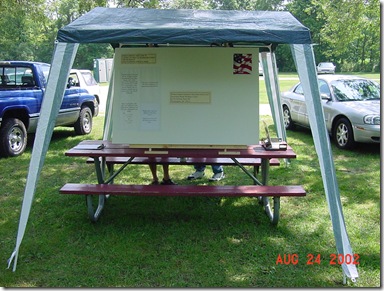
In 2002 the Indianapolis Area Local made a giant postcard that we took around the state that year collecting signatures in support of the Postal Workers at the processing plant where the two Postal Workers had died.
As little as a year later, on the anniversary of the 9/11 attacks, then IAL-President Eddie Beaver and I manned a booth on the Circle during the cities first 9/11 Community Fair passing out fliers about the steadfastness of Postal Workers during the anthrax attacks. We were astonished how many people were surprised to be reminded about the anthrax attacks. Most people had forgotten about anthrax or had absorbed those events into the whole Islamic terrorism memory of 9/11.
As postal workers we can take pride in our diligence and commitment during that hectic year.
imageMorris-smSo on this the 10th anniversary of both the 9/11 attacks and the anthrax attacks let's remember both events. Let's remember the two Postal Workers that died from anthrax exposure: Joseph Curseen(left) and Thomas Morris ((right)brother of Cumberland Window Clerk Sheila Howard) and let's remember how as we came to work every day we were the first responders to the anthrax attacks. 
So on this the 10th anniversary of both the 9/11 attacks and the anthrax attacks let's remember both events. Let's remember the two Postal Workers that died from anthrax exposure: Joseph Curseen and Thomas Morris (brother of Cumberland Window Clerk Sheila Howard) and let's remember how as we came to work every day we were the first responders to the anthrax attacks.
THE CREED
"Neither snow, nor rain, nor heat, nor gloom of night stays these couriers from the swift completion of their appointed rounds" APlan
Since the establishment of Postal Service in 1775 by the Second Continental Congress, Postal Workers have routinely been  placed in harms way:
  • Exposed to the hazards of frontier life and armed robberies from the early Colonial "Post Riders" to the experimental Railway Mail Service of 1862. 
  • From the brief but dangerous existence of the Pony Express, exemplified by the newspaper recruitment advertisements that read "Wanted: Young, skinny,     wiry fellows not over 18. Must be expert riders willing to risk death daily. Orphans preferred."  
  • From the death of the three American "Sea Post Clerks" in service aboard the HMS Titanic in 1912 and more through two World Wars. 
  • From the early days of aviation and the experimental testing of mail delivery by air to the modern day "Unabomber".  


IALAPWU Annual Picnic 2002
We collected over 3000 signatures and turned the Post Card over to Rep. Julia Carson to deliver to the Brentwood Area Local in Washington.
IALAPWU Annual Picnic 2002
Former IAL#130 President and current Regional Coordinator Sharon Stone, former IAL#130 President Eddie Beaver, the Late Congresswoman Julia Carson and Cumberland window clerk Sheila Howard at the 2002 Annual Picnic.
With the death of Postal Workers Thomas Morris, Jr. and Joseph Curseen, Postal Workers entered the age of bio-terrorism. In 2001 Postal Workers across the country demonstrated that the creed is more than an outdated reference to their duties. It exemplifies the dedication of Postal Workers to their work, the sanctity of their duties, and the significance of the U.S. Mail to the history and security of the country.

When the country was paralyzed by the events of September 11, 2001 and horrified by the subsequent anthrax attacks, Postal Workers continued in their duties without missing a beat. When Congress closed its doors because of the delivery of anthrax laden mail, the Postal Workers that delivered and processed that mail did not cower in their duties. When it was discovered that materials from contaminated postal facilities where delivered to the Critical Parts Center in Indianapolis, the 'non-postal' facility was immediately closed down. Indianapolis Postal Workers at the facilities and offices that delivered that material continued to perform their duties without interruption. With 20 postal facilities testing positive for anthrax contamination, Postal Workers in overwhelming numbers continued to report for work, well aware of the potential dangers.

Postal Workers across America continue to display a dedication to their daily duties that is only surpassed by the members of our Armed Forces and our unionized brothers and sisters in Police and Fire Departments across the country and unmatched in the private sector.
 Timeline Of The Attacks
  • Sept. 18, 2001: The first letters containing anthrax are mailed.
  • Oct. 4, 2001: Bob Stevens of American Media in Florida is hospitalized with inhalation anthrax.
  • Oct. 5, 2001: Stevens, 63, dies.
  • Oct. 8, 2001: Anthrax is found in the Boca Raton, Fla., The building is closed.
  • Oct. 9, 2001: More letters laced with anthrax are mailed.
  • Oct. 12, 2001: An NBC employee in New York City tests positive for anthrax poisoning.
  • October 15: A letter to Senator Daschle is opened. The anthrax in the letter was described as a "fine, light tan powder" which easily flew into the air.
  • Oct. 16, 2001: The 7-month-old son of an ABC News freelance producer tests positive for anthrax poisoning.
  • Oct. 18, 2001: A CBS employee and a New Jersey postal worker test positive for anthrax poisoning.
  • Oct. 23, 2001: Two postal workers from the Brentwood facility in Washington, D.C., are confirmed to have died from inhalation anthrax.
  • Oct. 26, 2001: A U.S. State Department mail room staffer is hospitalized with anthrax poisoning.
  • Oct. 28, 2001: A second New Jersey postal employee tests positive for anthrax poisoning.
  • Oct. 30, 2001: A New Jersey patient is reported with anthrax poisoning.
  • Oct. 31, 2001: A hospital employee in Manhattan, dies from inhalation anthrax.
  • Nov. 21, 2001: Ottilie Lundgren, 94, of Connecticut, dies from inhalation anthrax. Dec. 2003: After more than $130 million worth of renovation and cleanup the Brentwood postal facility reopens in Washington, D.C..
  • July 29, 2008: Bruce E. Ivins, the second government scientist suspected in the 2001 anthrax attacks, commits suicide.
  • Feb. 19, 2010: The FBI, Department of Justice, and the U.S. Postal Inspection Service formally conclude their investigations of the anthrax mailings. According to the DOJ report: "Evidence developed from [the] investigation established that Dr. [Bruce] Ivins, alone, mailed the anthrax letters."
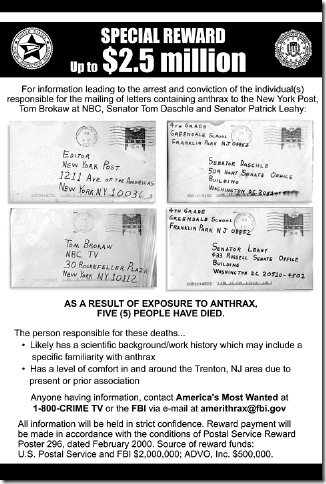
  • Feb. 15, 2011: A group of independent scientists convened by the National Academies of Sciences  concludes that scientific evidence is consistent with the idea that Bruce Ivins could have been the perpetrator of the anthrax attacks that killed five people in 2001. But taken on its own, the science doesn't prove Ivins did it, the panel says. The new report is limited to an evaluation of the scientific evidence and does not assess the guilt or innocence of anyone connected to the case.Anthraxreward
Sources: